Close-Order Drill
Also see Cadences or the main NROTC page
What is Close-Order Drill?
The American Heritage Dictionary defines close-order drill as "A military drill in marching, maneuvering, and formal handling of arms in which the participants perform at close intervals." In the early days of musketry, such training and synchronization was essential to formations and tactics in battle. Today, it holds a more ceremonial role, leading one to ask...
Why Drill?
- Bearing and Leadership/Followership. Navy and Marine Corps leaders must be able to give and receive orders clearly and professionally; whether as OOD of a ship or commander of a platoon, one's orders must be given with a good "command voice." Close-order drill is a great way to practice this.
- Knowledge. In the Navy or Marine Corps, you must know the basics of close-order drill: military personnel (especially in the Marine Corps) are expected to be able to lead and perform basic drill movements as part of their profession. (Even parts of the Navy which don't typically do drill occasionally have ceremonies requiring it, like Changes of Command.)
- Fun. Is "fun drill" an oxymoron? Well, it can be fun when you get it just right, a cool feeling when the musical rhythm jibes exactly with everyone's precision movements. It's even more fun when you call cadences. Think of it as a game.
Tips, Tricks, and Techniques
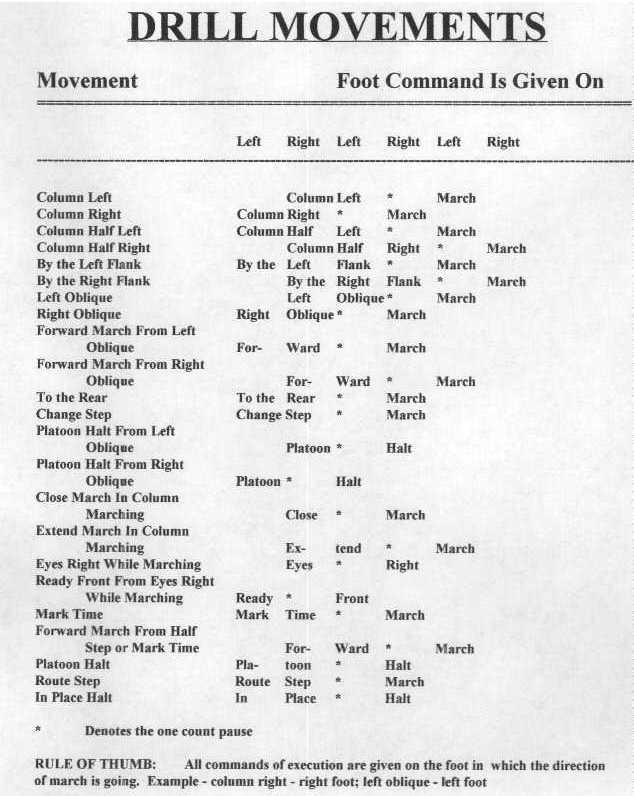
- All the commands of execution (usually MARCH!) occur on the foot that you're turning towards. For example, when you do COLUMN LEFT, MARCH! the MARCH occurs on the left foot. Because one pauses a beat before the command of execution, this means that columns and obliques start on the opposite foot that you want to turn (e.g. the COLUMN for column left is said on the right foot), while flanks and half-columns start on the same foot for turning.
- Why do Drill Instructors sound funny? You may have noticed that experienced Drill Instructors say things like "Harch" instead of "March." There is a method to the madness: consonants like "h" are short and clipped (it's very difficult to draw out, especially with any volume) while other consonants can be elongated (you can hum an "m" or hiss an "s" for quite a while). If you replace the command of execution's initial consonant with an "h" (e.g. "About HACE!" "Forward HARCH!"), you make it easier for everyone to start at the exact same time.
- When do you put your arm down for dress right dress? There are lots of times (like the first squad on FALL IN, after EXTEND MARCH, etc.) when you put up your arm to ensure good spacing, but only on OPEN RANKS and DRESS RIGHT DRESS do you need to be explicitly told READY, FRONT. In all other cases, the rightmost person drops his/her arm when the person to his/her left has stopped moving, and so on down the line.
- When marching in a oblique (at a 45° angle), on the command HALT one has to stop facing straight (that is, at 0°, not plus or minus 45°), which means that your last foot has to plant itself at a quarter turn so that when you bring your feet together, they are both facing forward. On the command IN PLACE HALT, you stop at 45° (likewise, MARK TIME continues at 45°). If one has been halted with IN PLACE HALT, FORWARD MARCH means go back to 0° while RESUME MARCH means continue in the direction of the oblique. Yes, it's all a bit confusing, but it makes sense if you think about it a bit.
- Which foot does PLATOON HALT come on? It depends. Technically, you can do either foot, although it feels better when the command of execution (HALT) is on the right foot...which means that if one elongates PLAH-TOON (à la Parris Island) one starts on the left, and if one does a one-count PLATOON (como San Diego) one starts on the right. My AMOI was from San Diego, so I always used the second method (one syllable "Platoon"). Short answer: start on the right foot, but in a pinch you can do either.
- Keep it slow: Stay at about 112 beats per minute...in the real thing, everyone's adrenaline will automatically speed it up a bit so it's closer to the 120 bpm as specified by the regs
- Platoon commanders do not stay in the front with the guidons as specified in the Drill Manual; this is more for parades. Rather, they should be on the left side of the platoon, somewhere between the middle and back. (When facing the platoon, one generally stays six paces out and centered.)
Useful Resources

- Marine Corps Drill and Ceremonies Manual (PDF) (MCO P5060.20, formerly NAVMC 2691/SECNAVINST 5060.22) - the granddaddy of all drill manuals; it includes great pictures of all the basic movements, along with clear descriptions. Above is a link to the part 1, which covers drill, but the rest of the sections (on ceremonies and rifle movements) are available on the Marines' Orders and Directives page. (NROTC UC Berkeley also has a copy online.)
- MCRD Parris Island Drill Manual - the bible for USMC drill instructors, this describes each movement in exact detail; chapters 1, 3, and 6 are perhaps the most useful
- Sea Scout Drill Manual - a bit simple, but it describes the basic movements in simple language
- Air Force Drill and Ceremonies Manual (AFMAN 36-2203) - Although it has funny terms like "flight" and "squadron" (the equivalent of "platoon" and "company" in the real military), much of it is stolen wholesale from the Marine Corps Drill Manual and thus it is a good reference. Finally, there's a great site called CadetStuff.org which has some humorous articles by "Dr. Drill," among other things.
- A Movement Cheat Sheet - from another NROTC unit, this summarizes which foot each movement begin on (note that it follows the Parris Island "plah-toon" method as opposed to the one-count "platoon" preferred by our AMOI)
NROTC UC Berkeley Platoon Commanders should check out the drill cards.
© 2001-10 by Luke Swartz